









Jobs: the engineer of the future? Hybrid professionals are leading the way
%20(2).jpg)
Rome, 19 May (Labitalia) - The engineering and IT consulting landscape is undergoing an unprecedented transformation. According to analyses carried out by agap2, a multinational operational consulting company specialising in engineering and IT, today’s labour market no longer rewards sector-specific expertise alone, but requires a broad vision capable of managing increasing complexity. The data and hands-on experience are clear: vertical specialisation, while naturally still essential, is no longer sufficient to guarantee business competitiveness. Companies are currently struggling to find hybrid profiles, namely professionals able to understand and interpret complex systems without limiting themselves to optimising a single segment of a process. According to agap2’s analysis, four areas are undergoing an unprecedented revolution.
· Management engineering: from process optimisation to supply chain resilience. The role of management engineering has expanded far beyond internal efficiency. Following the recent global supply chain crises, companies are no longer looking only for cost controllers, but for strategists capable of redesigning entire supply chains, making them resilient and sustainable. A new frontier is also emerging: investment funds and industrial advisors are increasingly seeking technical profiles capable of assessing startups and deep tech projects. This role of “technical-financial analyst”, which until a few years ago did not exist in a structured way, is now central to the competitiveness of the country’s economic system.
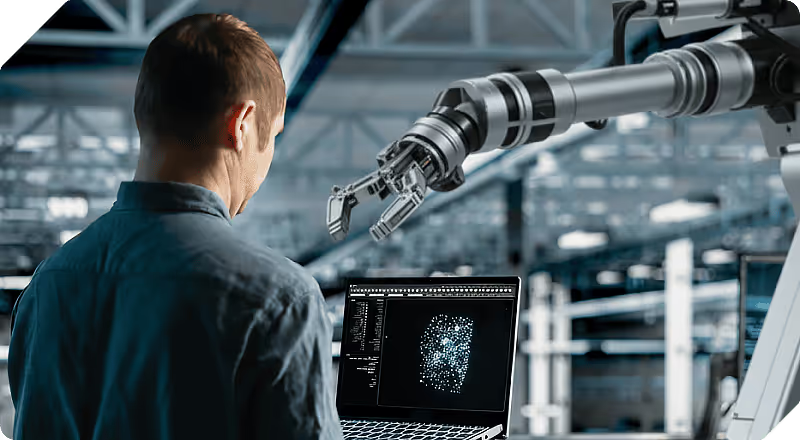
· Biomedical engineering: the blurred boundary between hospital and factory. This is the sector where technological convergence is most disruptive. Surgical robotics and motor-support or collaborative devices are eliminating the dividing line between the clinical environment and industrial production. The shortage of professionals able to operate seamlessly across these two worlds is now one of the main bottlenecks for innovation in Italy’s med-tech sector.
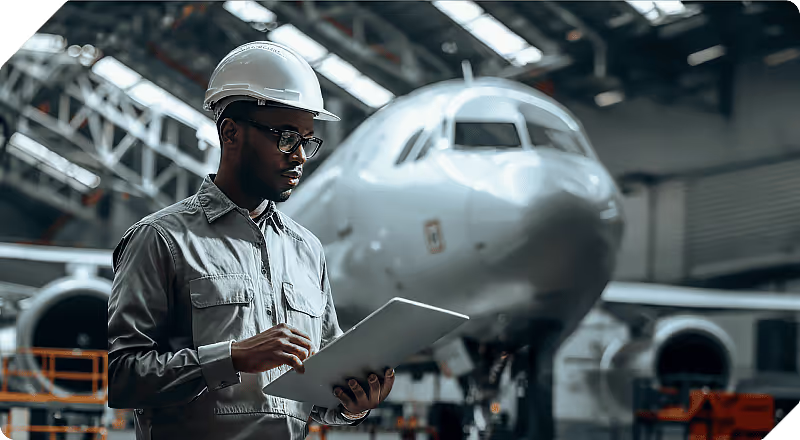
· Mechanical engineering: the beating heart of digital transformation. Although its name may evoke tradition, career opportunities have changed radically: thanks to digital twins, additive manufacturing and the integration of cyber-physical systems, mechanical engineers are now among the most sought-after profiles in industrial transformation processes. -Aerospace engineering: the era of the space economy. The growth of Italy’s space sector is now a concrete reality. From satellite communications to Earth observation for environmental purposes, the market today is profoundly different from what it was ten years ago. The Italian supply chain has finally expanded onto the international stage, making this area rich in opportunities.
From agap2’s observatory, three macro-trends are also emerging that are set to dominate professional opportunities over the next three years: Advanced manufacturing, which requires professionals able to manage the entire product lifecycle, from virtual simulation to physical production, through to predictive maintenance via IoT; Aerospace consolidation, which marks the transition from elite research to large-scale industrial production for satellite constellations; Technical finance, which represents the most surprising trend, with engineers entering the decision-making rooms of finance to support investors and advisors in the assessment of high-tech industrial projects — a rare profile, equipped with the essential “technical eye” needed to minimise investment risks.
“The current dynamics of the labour market in the engineering sector,” says Enrica Ceccato, HR director at agap2, “highlight a paradox: while demand for technical skills is growing, purely vertical specialisation is beginning to show its structural limits. Our analysis confirms that real added value has shifted towards the ability to oversee the intersection between different fields. Companies no longer need only experts in individual phases, but professionals capable of understanding and managing processes in their entirety. The real challenge for the education system and for consulting is no longer simply the transfer of technical know-how, but the development of a broad vision that makes it possible to integrate complex supply chains, from the management of resilient supply chains to the new frontiers of the space economy and collaborative robotics. The hybrid profile, therefore, is no longer an exception, but a fundamental requirement for ensuring the competitiveness of companies in our region and of the country as a whole.”
%20(3).jpg)