










Liguria sees surge in complex systems engineers: demand up 12%
.jpg)
Complex systems engineering is becoming one of the main drivers of technological development in Liguria. According to data from the Agap2 Observatory, part of the multinational company specialising in operational consulting for the engineering and IT sectors, demand for highly specialised technical skills has risen by 12% over the past year.
This increase is not simply linked to the need for new professional profiles. It also reflects a broader transformation: the acceleration of digitalisation and technological innovation processes across strategic sectors of the regional economy.
Among the key sectors leading this growth are defence, logistics and the naval industry — historic pillars of Liguria’s economy that are now entering a new phase of technological evolution.
Agap2’s new office in La Spezia
To respond to this growing demand for specialist expertise, Agap2 has decided to open its fifth Italian office in La Spezia.
According to Anna Barriviera, head of the new La Spezia office, Liguria is now a highly technology-intensive industrial environment.
“Liguria is currently a rapidly evolving technology ecosystem. Our decision to open an office in La Spezia stems from our desire to be directly present in the region and to become a strategic partner for local companies,” Barriviera explains.
The goal is not only to provide qualified professionals, but also to support the management of complex projects through an operational consulting model that brings together technical expertise, processes and strategic vision.
Defence, logistics and the naval sector lead innovation
Liguria’s industrial ecosystem is undergoing a profound technological transformation, supported by major investments and new innovation requirements.
One of the sectors driving this growth is the Ligurian District of Marine Technologies, where research focuses on advanced systems and increasingly digitalised infrastructure.
Companies are increasingly looking for professionals able to integrate advanced mechanics, electronics and software — essential skills for developing autonomous technologies and resilient critical infrastructure.
Logistics: increasingly digital port infrastructure
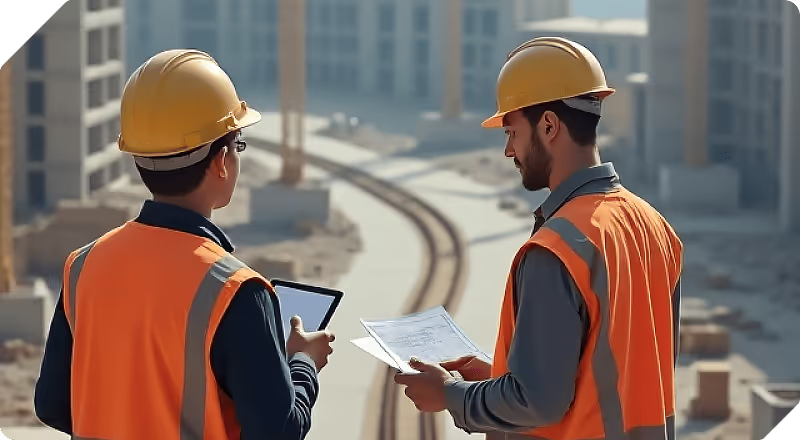
In port logistics, technological innovation has radically changed the way infrastructure and goods flows are managed.
Today, the challenge is no longer limited to transport. It also involves keeping port infrastructure operational and secure through advanced digital systems.
Engineering activities focus on:
- predictive maintenance of assets;
- design of integrated logistics systems;
- development of interactive digital manuals;
- optimisation of maintenance cycles and spare parts management.
In a strategic hub such as La Spezia, efficiency is measured by the ability to integrate data, technologies and operational flows.
Defence: complex systems and digital security
The defence sector is another key area for innovation in Liguria.
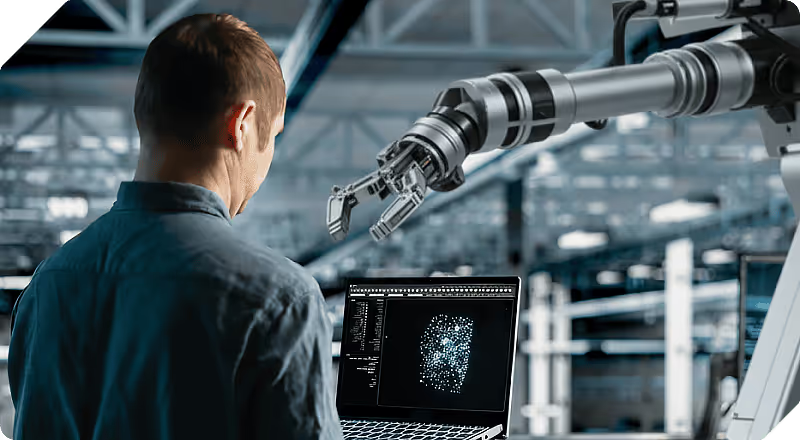
Engineering activities focus on the integration of complex systems, where electronics, software and mechanics must work together in a coordinated and secure way.
The main areas of development include:
- maritime monitoring systems;
- advanced surveillance sensors;
- digital architectures protected against cyberattacks;
- simulation platforms for security scenarios.
The objective is to design reliable technologies capable of operating in critical environments that are strategic for national security.
Naval sector: innovation between engineering and design
The naval sector continues to be one of the strengths of La Spezia’s economy.
The local district includes companies ranging from large-vessel construction to luxury yachting, with projects that are increasingly complex and highly customised.
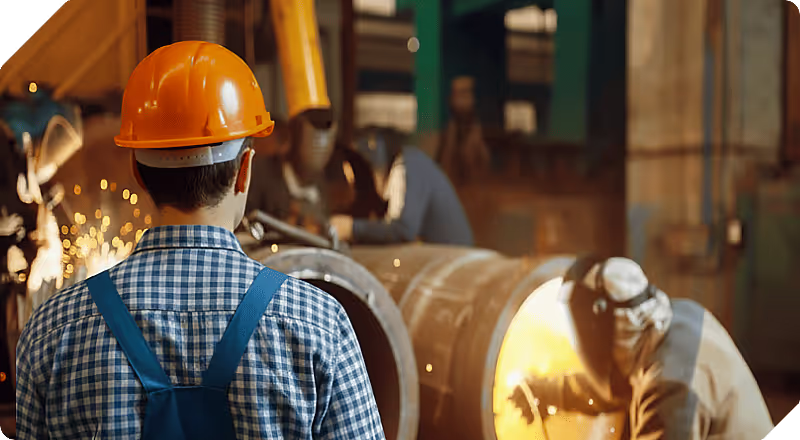
Here, innovation mainly concerns the integration of structural design, onboard systems and digital technologies.
New vessels require seamless integration between:
- hull architecture;
- advanced navigation systems;
- onboard automation and digital technologies.
New skills to manage complexity
According to Agap2, the market is no longer looking only for specialists in individual disciplines, but for professionals capable of managing complex, multidisciplinary systems.
Data analysis, artificial intelligence and machine learning applied to naval maintenance and the simulation of defence scenarios are becoming central tools for maintaining a competitive edge.
The new La Spezia office aims to become an innovation and development hub, creating new opportunities for the local area and strengthening the link between industry, technology and advanced skills.
%20(3).jpg)
%20(2).jpg)