











2026 for Business Leaders: Flexibility, AI, and Empathy as Drivers for Growth
.jpg)
Critical Skills and the Talent Shortage: The Human Capital Challenge
While Artificial Intelligence and flexibility are redesigning work structures, human capital remains—now more than ever—the true critical factor. The 2026 HR Barometer by the international operations consulting firm agap2 identifies four key drivers set to shape the job market: Artificial Intelligence, well-being, the green transition, and the talent shortage. The C-Suite’s primary challenge in the coming months will be navigating the complex balance between these four forces.
The Skills Gap and National Competitiveness
The starting point is a familiar one: the demand for technical skills is skyrocketing, particularly for highly specialized roles such as AI and Machine Learning engineers, Data Scientists, cybersecurity experts, and specialists in industrial automation and renewable energy. These roles are essential for driving digital innovation and the energy transition, yet they are increasingly difficult to source.
Data cited by agap2 confirms that Italy alone requires approximately 20,000 new engineers per year to bridge a structural gap. This shortage is not just a corporate hurdle; it risks stalling the competitiveness of the entire national economy.
AI as an Enabler, Not a Substitute
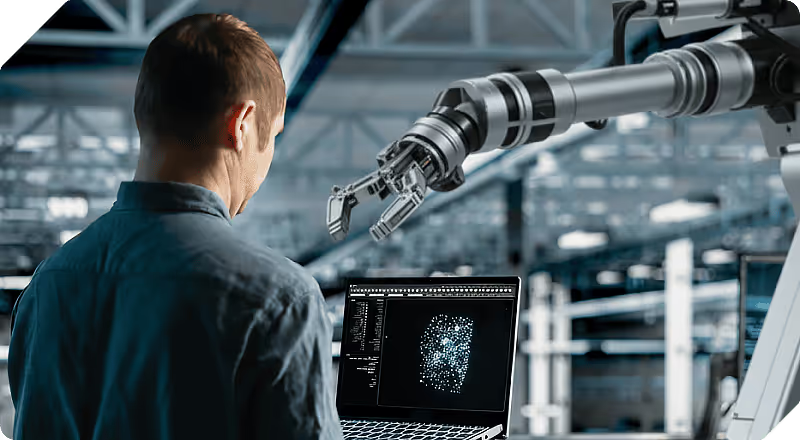
In this landscape, Artificial Intelligence is not viewed as a threat to employment or a replacement for workers, but as an enabler of new forms of collaboration between people and technology. While machines handle routine tasks, professionals are encouraged to engage in continuous reskilling and upskilling. The goal is to develop the necessary expertise to manage the rapid change dictated by an increasingly pervasive digitalization process.
The Rise of the "Emotional Salary"
The focus on the human element is also reshaping talent acquisition: well-being and work-life balance are no longer optional perks but strategic pillars. According to agap2 experts, companies must move away from control-based models toward trust-based approaches.
Well-being is becoming an integral part of the Employee Value Proposition and a key component of the "emotional salary." Today’s workers are no longer willing to sacrifice their personal life for their professional one—especially in sectors where job offers far outnumber available candidates.
%20(3).jpg)
%20(2).jpg)